
Skip to content
Limited Spots
Unlimited SEO Focus
Business owners searching for a chartered accountant do not browse passively. They search with urgency, typically at a tax deadline, a cash flow crisis, or a growth decision where qualified financial guidance becomes critical. The cluster of near-me variants for accountancy searches collectively generates around 27,000 monthly searches in the UK, and Google AI Overviews do not appear for these local queries, meaning the local map pack remains the dominant result every time. The firms appearing at the top of those results are not there by accident.
The UK accountancy sector is one of the most search-driven professional services markets in the country. Searches for self assessment accountants, VAT return specialists, small business bookkeeping, corporation tax advisers, and Making Tax Digital compliance support run at sustained volume year-round, with sharp spikes during the January self assessment filing period and again ahead of major regulatory deadlines. In February 2026, Google searches for Making Tax Digital reached an all-time recorded high in the UK, a 614% increase compared to December 2025, driven by the April 2026 landlord compliance threshold, and every one of those searchers needed a qualified accountant.
Business owners do not call first. They search, compare credentials, read Google reviews, assess whether a firm understands their sector, and decide before they ever make contact. Proximity signals contribute 66% of local pack rankings in accountancy searches, and firms appearing in the Google local pack capture 75% of clicks for high-intent queries such as “chartered accountant in Manchester” or “VAT accountant Birmingham.” The business owner running that search is already qualified. They know the service they need. Your only task is to be visible when they look.
Google classifies accountancy and financial guidance content as YMYL, Your Money or Your Life, which means your website is evaluated against a materially higher quality standard than a retail business, a gym, or a recruitment agency. Service pages covering tax planning, VAT compliance, payroll, Making Tax Digital, and financial reporting are assessed for technical accuracy, practitioner credentials, regulatory standing, and the overall trustworthiness of the organisation behind the content.
E-E-A-T, which stands for Experience, Expertise, Authoritativeness, and Trustworthiness, is not optional in this sector. Following the 2025 Google core updates, the ranking gap between accountancy firms with verified practitioner attribution on service pages and those without widened significantly. Thin content, anonymous authorship, and pages that fail to demonstrate genuine professional experience are active ranking suppressors, not minor weaknesses. A page missing named author credentials, ICAEW or ACCA membership references, and structured professional context will not rank competitively in this vertical regardless of how technically clean the site is.
Regulated financial promotion rules and FCA compliance considerations also govern how accountancy content is framed online. A content strategy built without awareness of these constraints creates both regulatory exposure and organic trust damage simultaneously, undermining the very E-E-A-T signals that Google rewards most in YMYL financial content.
Most SEO agencies managing professional services accounts operate at scale, assigning 150 to 200 clients to junior executives following templated checklists. The Cubas caps its client roster deliberately to four or five active accounts at any time. A senior strategist owns your campaign from audit to monthly reporting with no delegation, no templated output, and no deliverable disconnected from your specific service mix, practice location, and target client profile. Every recommendation maps directly to a ranking movement or a measurable revenue outcome.
Every core service your practice offers requires its own dedicated page with its own keyword architecture, clinical depth, and E-E-A-T signals built in from the structural level. A single services page listing tax, payroll, VAT, and audit together will rank for none of them because it sends no clear topical signal to Google for any individual query. We build standalone pages for every core service in your portfolio, each geo-targeted to your practice location across cities including London, Manchester, Birmingham, Bristol, Leeds, and Edinburgh, structured around how business owners actually search, and built with AccountingService, LocalBusiness, and FAQPage schema markup to maximise visibility in both organic search and AI-assisted research tools including ChatGPT and Perplexity.
Our service page audit uses a proprietary 47-point checklist covering keyword architecture, internal linking depth, schema implementation, author attribution, and content scroll depth benchmarks. Accountancy service pages built to this framework consistently achieve session durations above four minutes and content scroll depths above 75%, both of which feed directly into Google’s quality assessment of your firm.
The local map pack sits above organic results for the majority of high-intent accounting searches, and proximity signals account for 66% of local pack rankings. Your Google Business Profile governs whether your firm appears in that pack at all. We optimise every field including service-level listings for tax, payroll, VAT, bookkeeping, audit, and Making Tax Digital advisory, correct primary and secondary category assignments, add consultation and appointment booking links, and maintain a structured post schedule aligned to the UK tax calendar including self assessment deadlines, corporation tax filing windows, and MTD compliance milestones.
NAP consistency between your GBP and every relevant UK directory is audited and enforced using our citation gap analysis process so that no discrepancy in your trading name, address, or phone number creates ambiguity about your firm’s location or professional legitimacy.
Inconsistent NAP data across directories is one of the most common reasons UK accountancy firms plateau in local search despite having technically sound websites. We audit every existing citation and correct inconsistencies across Yell, Thomson Local, Checkatrade, the ICAEW firm finder directory, the ACCA find-an-accountant tool, Companies House profile alignment, and Trustpilot. We then build new citations in directories carrying genuine local and sector authority across your primary and secondary target cities.
For firms that have rebranded, moved premises, or merged with another practice, citation cleanup alone is frequently the fastest visible SEO gain in the entire strategy before any content or link building work begins. Our citation correction process typically identifies between 12 and 40 inconsistent entries across an average UK accountancy firm’s existing directory footprint, each one creating a small but compounding trust signal penalty in local search.
We are currently accepting enquiries for a limited number of new SEO clients. If your chartered accountancy practice is ready for focused, senior-led SEO that performs across Google, Bing, and AI search including direct citations in ChatGPT and Perplexity, we want to hear from you.
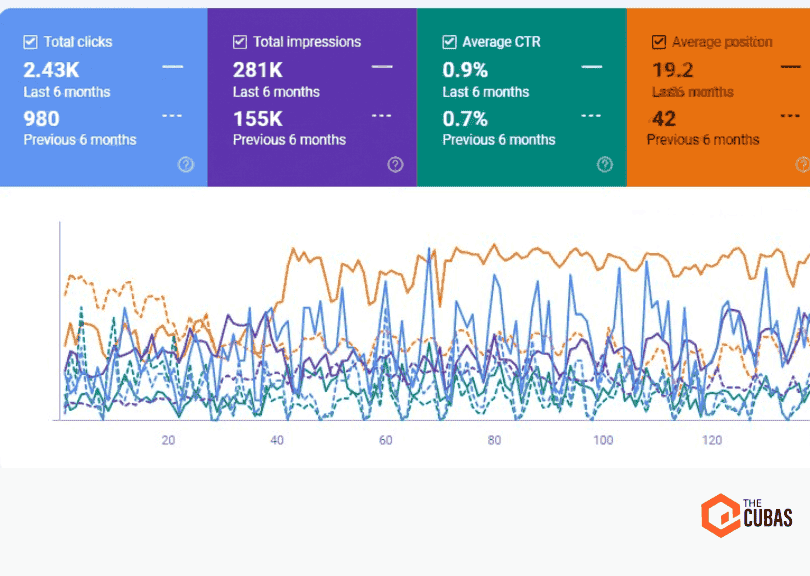
Accountancy practices with properly structured service pages, active and fully optimised Google Business Profiles, and consistent review generation outperform competitors across every local market in the UK, from sole practitioner firms in Bristol and Sheffield to multi-partner practices in London and Manchester. One practice The Cubas worked with had no page-one visibility for any core service term, a Google Business Profile untouched for over nine months, and every service compressed onto a single page with no individual keyword targeting. Within five months of deploying the full strategy, they ranked page one for six core service terms including self assessment, VAT returns, Making Tax Digital advisory, and small business accountant, grew organic sessions 71% year-on-year, and increased Google Maps enquiries by 130%.
SEO
We took a brand-new Bristol business with no search visibility, no backlinks, and no digital presence and outperformed 15-year incumbents across Organic Search, Google Maps, and AI Recommendations.
SEO
We took Tradestone Heating from low search visibility to first-page Google rankings and direct ChatGPT citations for the emergency service keywords that convert into real jobs across Bristol.
How long before we see SEO results?
Your Answers About SEO, Delivered Clearly
What does your SEO process include?
Most chartered accountancy firms working with a structured SEO strategy begin seeing measurable movement in local pack rankings within three to four months, with page-one organic positions for core service terms typically established between months five and eight. Timeline depends on the current state of your Google Business Profile, whether service pages exist with appropriate keyword architecture, the quality and consistency of your existing citation footprint, and the competitive density of your local market. Firms entering with no existing page-one presence and a dormant GBP tend to see the fastest early gains from citation correction and GBP optimisation before content and link signals compound over subsequent months.
Yes. A single services page listing tax, payroll, VAT, bookkeeping, and audit cannot rank competitively for any individual service term because it sends no clear topical signal to Google for any of them. Each core service requires its own dedicated page with targeted keyword architecture, structured headers, schema markup, and E-E-A-T signals including named author attribution and ICAEW or ACCA credential references. A business owner searching for “self assessment accountant in Birmingham” carries a specific search intent, and only a page built around that exact intent will rank for it.
E-E-A-T stands for Experience, Expertise, Authoritativeness, and Trustworthiness. Because Google classifies financial guidance content as YMYL, your website is evaluated against a significantly higher standard than most other business categories. Practically, this means your service pages need named and qualified authors, references to ICAEW, ACCA, or AAT membership, accurate and current technical content, and structured trust signals throughout the site architecture. Pages lacking these elements are actively suppressed in rankings even when technical SEO is clean, and the gap between attributed and unattributed financial content widened further following the 2025 Google core updates.
Google Business Profile is the single most important local search asset for UK accountancy practices. Proximity signals account for 66% of local pack rankings, and the local pack consistently appears above organic results for high-intent queries such as “accountant near me” or “VAT accountant in Leeds.” An optimised GBP with complete service listings, correct ICAEW or ACCA category data, active review generation, and NAP consistency across directories significantly increases the probability of appearing in that pack. Practices with dormant or incomplete profiles are effectively invisible for the searches with the highest conversion potential.
Yes, and niche service page targeting is one of the most commercially effective SEO strategies available to UK accountancy practices. Rather than competing broadly for high-volume generic terms, building dedicated pages targeting phrases such as “accountant for contractors UK,” “landlord tax accountant,” “ecommerce VAT specialist,” or “R and D tax relief accountant” allows your firm to rank for searches with significantly higher conversion intent and lower keyword competition. These niche pages also carry inherently stronger E-E-A-T signals because they demonstrate sector-specific professional depth, which both Google’s quality raters and prospective clients interpret as evidence of genuine expertise rather than generalist positioning.
Google Ads generates immediate visibility but stops entirely the moment budget runs out, and cost-per-click for competitive accountancy terms in UK cities runs between £8 and £35 per click with no residual asset value. SEO builds an organic ranking position that compounds over time, generates traffic without a per-click cost, and consistently achieves higher click-through rates than paid results for high-intent professional service searches. For accountancy firms where client lifetime value can reach £240,000 or more, the return on a well-executed SEO campaign generating even two or three net new client instructions per month significantly exceeds the total investment cost. The most effective medium-term approach uses both channels, with SEO progressively reducing paid dependency as organic authority grows.
Making Tax Digital is one of the most significant organic search opportunities available to UK accountancy firms right now. Google searches for Making Tax Digital reached an all-time recorded high in February 2026, a 614% increase on December 2025 levels, driven by the April 2026 landlord and sole trader compliance thresholds. According to HMRC statistics published in August 2025, approximately 42% of the seven million taxpayers with income from self-employment or property will need to comply with MTD between 2026 and 2028, and the vast majority of them will search for a qualified accountant to help them do it. Accountancy firms with dedicated, well-structured MTD service pages and an optimised GBP are positioned to capture this demand at its peak. Those without them are leaving a defined and time-sensitive client acquisition window open for competitors.
The Cubas is a specialist SEO agency working with high-value service businesses across Bath, Bristol, Milton Keynes, Oxford and Leeds. We focus entirely on SEO combining local SEO, technical SEO, sector SEO, and AI search optimisation to build lasting organic visibility.
28 Hodges Close, Swindon, United Kingdom, SN1 7DX
07917 399886
Copyright © 2026 THECUBAS LIMITED. All Rights Reserved